Tuesday, June 15, 2010

Gabriella joins CP!

Written by a CP Intakes volunteer


Gabriella was found on the streets by a woman who also owned a terrier. She was such a loving little girl, her new owner decided to try to integrate her into her family. After several months at her new home, Gabriella was still not getting along with the resident dog. A call came into Col. Potter to find her a new home.

Recently, Gabriella, a 16lb, black brindle beauty made her way to her CP foster home.

Please give Gabriella a warm CP welcome.

2 handsome fellows join CP

Written by a CP Intakes volunteer

A call came into CP from a shelter that was over it’s capacity and needed to move some dogs out or...

Two cairn terriers were found on the streets, dirty, hungry and lonely. One was neutered, one wasn’t. One was microchipped, the other wasn’t. As often happens, the microchip wasn’t registered. After the required holding period, could we take these two little boys? We could, and we did. Both cairns are estimated to be less than 2 years old.

Manassas is the more “mature” cairn of the two. He weighs a mere 13lbs, but he thinks he is much bigger than that.


Walton, the chubby one, weighs 16lbs, and still acts very much like a puppy.


I’d like everyone to give Manassas and Walton a great big CP welcome.

Monday, June 14, 2010

ENJOYING SUMMER BEACH VISITS WITH YOUR DOGS- ARE YOU A RESPONSIBLE VISITOR?


Gordon M. Grant for The New York Times

Matt Norklun says it isn't.


IF you go down to Wiborg Beach on the early side say, 7:30 a.m. the first person you might run into is Steven Gaines, the author, who comes with his dog Shepsil. I'm here every single day of the year, even if there's a snowstorm, he said.

By 8 a.m., more dogs arrive, accompanied by people wielding cups of coffee and tennis-ball flingers. If it's a summer weekend, there will be several dozen dogs, frolicking on the sand and in the water while their owners mingle. Nearly everyone carries a Mutt Mitt, a plastic bag for removing waste.

It's a way to meet people, said Mark Stearns, who drives with his wife and two French bulldogs from Philadelphia to East Hampton every weekend, year-round. We've met a lot of people because of the dogs.

Just before 9 a.m., the dogs and their owners trek to the parking lot, complying with a law that bans dogs from the beach after 9 a.m. and before 6 p.m. during the summer season. By day, the families with their children trickle in, setting down towels on the sand that the dogs have vacated.

This is where the conflict comes in.

There's poop out there everywhere, and when it gets hot out here, it stinks so bad, said Suzzanne Fokine, a year-round resident who uses the beaches daily for exercise and meditation. We wouldn't let our kids poop on the beach, so why do we let dogs poop on the beach?

Forget the artists-versus-writers softball game or the quest for a reservation at Nick and Tonia's. The real battle line in East Hampton lately has involved the continuing feud between dog owners, who say they are diligent about picking up after their pets, and other beachgoers, who point to evidence otherwise.

It's as much a clash of mind-sets as it is of beach manners. I think the people who are dog owners and dog lovers are not really good at seeing the other side, said Steven A. Ludsin, who frequents Georgica Beach and wishes that dogs did not. They sort of feel like, ˜Why don't you love my adorable little dog?"

The controversy grew acute over the winter, when officials in the Village of East Hampton floated the idea of cutting back the hours for dogs on the beach say, from 7 p.m. to 8 a.m. in the high season. This prompted many residents here to do what they do best when they are outraged: write well-worded letters to The East Hampton Star, the weekly newspaper.

It also prompted some to form a committee (another of the village residents strong suits). Kathryn Staley, who has a cairn terrier, and Maureen Bluedorn, who has two cairn terriers, organized a group called BeachDogs11937 referencing the East Hampton ZIP code to work against any new restrictions.

You know how it is in New York City, some people just spoil it for everybody, said Ms. Staley, who commutes between Manhattan and East Hampton. There are some people who just never pick up after their dogs and always keep them unleashed. Most of us abide by the rules and clean up the beach as we walk.

During the off season, BeachDogs11937 worked amicably with village officials, and the upshot was that the rules for dogs on the beach were not altered. In exchange, the dog owners agreed to hold beach cleanups every month this summer and start an education campaign with T-shirts, pamphlets and radio ads to coax people to pick up after their dogs.

I think this year will be a good test for us, Ms. Bluedorn said. Larry Cantwell, the village administrator, is the point person for complaints about beaches, which he calls the crown jewels of the village. He also fielded all the angry e-mail messages from the dog lovers who worried about the potential rule changes.

When you have a conflict between people going to the beach and enjoying it with their children and dogs that spoiled the beach, it's a serious matter, he said. When you receive a phone call from a parent whose child has picked up dog feces on the beach, we take that seriously.

Which leads us to the story of Matt Norklun. A longtime East Hampton resident, Mr. Norklun has seen it all: dogs biting joggers, attacking birds, killing a seal, soiling on people and their belongings. At Georgica Beach, people wash their dogs in the hot showers with soap that are meant for humans, he said.

In 2008, he grew so exasperated that he took a Mutt Mitt, collected samples at Georgica Beach, and left it on the steps of Village Hall. Mr. Cantwell, who had to clean it up, was not amused, and Mr. Norklun was fined $500 for littering.

Mr. Norklun said his fine was paid entirely by neighbors who support his crusade but do not want their names associated with it. I'm not anti-dog, he said. It's just there's a place for everything, and the beach is not a place for dogs. Imagine a kitty-litter box: would you put your hand in it?

RelatedTimes Topic: Dogs

One thing both sides agree on: the summer people make that, the citiots, are to blame.
On a Friday evening, they drive out from the city and go straight to the beach, Mr. Norklun said. They're like, 'O.K., here we are at the toilet, let the dog out.' A lot of times they don't even get out of the car.He complains that the police department turns a blind eye. They hand out thousands of parking tickets every day, and they can't get one kid to go to the beach? Mr. Norklun said.

Actually, an officer patrols the beach by car every morning. It's one of our top priorities, said Gerard Larsen Jr., the village police chief. But we can't be everywhere all the time, and it's probably a small percentage of the people who aren't cleaning up.Last year, enforcement was stepped up, with officers starting beach patrol at 7 a.m. rather than 9 a.m., but to little avail. I don't think we've issued one summons yet for people not cleaning up, Chief Larsen said. It's like driving enforcement: when the cops are there, everybody slows down.

Most beaches in the United States don't allow dogs, period, but East Hampton has been relatively lenient. In the olden days, perhaps the 1980s when Main Street and Newtown Lane were dominated by mom-and-pop stores, the issue was less pressing, since there were fewer people and dogs. But now that the village has enough residents and visitors to attract the biggest names in retail Hermes! Gucci! Tiffany! the matter has come to a head.

According to the village government's Web site, the population of East Hampton village which is a subset of the Town of East Hampton is 1,388. But on summer weekends, that swells to an inestimable number (not counting houseguests). On a Saturday night in August, 1,388 may represent the population of the East Hampton movie theater plus the people trying to get a table at Rowdy Hall.

The crowds were back on Memorial Day weekend, when BeachDogs11937 held its inaugural cleanup. Anne Haring, who helped dispense T-shirts at Wiborg Beach, recalled the days when bringing a dog was no big deal.

There are more people, more children now, she said. There's also been the whole cleanliness thing about germs. People are phobic about germs.Mr. Gaines, who chronicled the excesses of the Hamptons in his book Philistines at the Hedgerows, used the phrase a sense of entitlement to describe careless dog owners, and worried aloud about the potential loss of a pleasurable morning ritual.

This is really the friendly, happy beach, Mr. Gaines said, gesturing to the crowd of people and dogs. This is a very important part of living here.

Sunday, June 13, 2010

Sports Fathers Now Playing in CP!

Written by CP's VP of Intakes

My heart always skips a beat when I'm contacted about taking in a large group of cairns. It's sort of like being at a highly contested sporting event -- the thrill of victory and the agony of defeat. You want so badly for your favorite team to win, but know that's not always going to happen. But, this game also went into overtime. We originally were expecting seven older puppies and adult males. Monday the owner of the breeding facility contacted me asking if we would want to take three 11 week old puppies as well.

Luckily for these kids, the Col. Potter team came through with flying colors and we have the thrill of victory to savor thanks to our wonderful foster homes who stepped up to foster these furkids at a time when we are extremely full. This one definitely took a team effort, not only for foster homes, but in getting them picked up during the week, then arranging transportation next week to get them closer to the Cairn Rescue Annual Party (CRAP) and foster homes and transporters.

With Father's Day only a week away, what better way to honor all father's than by remembering some of sports great father and child(ren) families? Let's give a Col. Potter round of applause for the newest members of our team:

Manning: Male, 4 years old, dark brindle


Griffey: Male, 4 years old, dark brindle


Earnhardt: M, 2 years old, black brindle


Dorsett: M, 2 years old, dark brindle


Howe: M, 7 months old, dark red brindle


Ripken: M, 7 months old, dark red brindle


Norton: M, 7 months old, black brindle


Ali: Female, 11 weeks old, wheaten


Petty: Male, 11 weeks old, wheaten


Weber: M, 11 weeks old, wheaten


My favorite team is Col. Potter. These TEN Sports Fathers have already won by making their way to CP. Now they are set to join their foster families and learn the rules of games and...freedom!

Sunday Sweets

Sunday is full of SWEETS! Each week we will showcase the sweeter side of Cairns. If you have a sweet filled cairn and would like us to consider YOUR picture for an upcoming "Sunday Sweets" send it to us at cpcrnblog@gmail.com! (All photo submissions become the property of CPCRN and may be used for fundraising, promotion and/or outreach purposes.)

Tazzer

Kerwin

Rocky & Miri

Oyster (fka Daiquiri)

Missy

Lucy Dell

Saturday, June 12, 2010

Introducing CP's newest bundle of joy!

Written by a CP Intakes volunteer


This time of year is hard for shelters. The warmer weather is upon us. Dogs are left outside more often than not. Tiny bundles of joy found under the Christmas tree are no longer little, cute or wanted.

Lanski found himself alone, in a remote country shelter. He was pulled at least once from the "do not return line" before CP was able to get a volunteer to free him. He is estimated to be 11 months old, weighs only 11.5lbs, and is in desperate need of grooming and vetting.

Please give a warm CP welcome to Lanski, CP's newest bundle of joy.

Welcome Slattery to CP!

Written by a CP Intakes volunteer


Slattery is yet another little senior cairn boy who found himself in a shelter with very little chance of getting out alive. The shelter manager contacted Col. Potter and asked if we could take him. A few days ago he became part of the CP family

One of the shelter volunteers reports that “he’s a sweetheart – very calm for a terrier. He loves going for walks but because of his age (estimated to be 8-10 years old) and his weight, he couldn’t walk as far or as fast as he wanted to. With a little portion control of his food and short walks every day he could become a wonderful little walking companion and friend. He loves rolling in the grass and having his belly rubbed.”

Welcome to the good life, Slattery!

Friday, June 11, 2010

Ozmudder has many talents!

Contributed by Kathy C., 'Ozmudder'

This is Skeeter and Cinny on the Porch - Lunch sketch


We hope you enjoy this as much as we do. You can follow this link to check out the Oz Project website which chronicles the history of this wonderful refuge for some of our neediest intakes.

Friday's Funnies

Thursday, June 10, 2010

The Heart of Col. Potter - the foster home

Written by a CP Foster Mom


Col. Potter foster homes like to say that if you have room for a dish, a bowl and a bed, you have room to take a foster. We just had our long term foster find his forever home and as everyone adjusts to life with ONLY 3 dogs, it becomes apparent to all of us that our fosters don't just live in our homes, they live in our hearts.

Each of our fosters comes with some baggage, maybe an owner surrender because of the economy or a death in the family, a dog who didn't fit in with the new baby, more recently we are happy to be able to transition dogs from commercial breeding facilities to lives as beloved companion animals. Some of these dogs become long term fosters because they have so much to learn after lives spent in cages with little affection or medical care.

Our foster came to us as a very scared little guy and left as a dog that you would be hard pressed to believe that he grew up in a cage. He became easier to be part of our pack than our own dogs at times since we taught him everything he knew, we knew how he would act or react in certain situations. We soon found that he needed to 'practice' nearly everything in a calm, not too many people around set up and then he was ok with doing it.

Like parents who see their children grow to young adulthood, we feel pride at all that our foster accomplished and have hope for his future as a loved little guy with a new home and mom who will watch out for him in the future. A coworker asked me ' how do you teach or train a dog like that ?- I guess you have to have a passion'. I think she's right.

If you would like to foster a cairn and become part of this wonderful opportunity to rehabilitate a cairn, please click here.

Anna and Kody playing or Cairns really are BIG dogs at heart!

Contrubuted by Kody and Anna's mom

It was such a nice morning, only 60 degrees compared to 90's last week, so I decided to take a video of Kody and Anna playing, they were feeling pretty frisky. Anna is my mill momma that I fostered for Col. Potter and then adopted. You can tell she really enjoys rolling in the grass, which she hasn't been able to do in 6 years. Kody is my big baby girl, Alaskan Malamute mix and she is wonderful with the little ones. Kody and Anna are best friends. Hope you enjoy.


Wednesday, June 9, 2010

AVOIDING, RECOGNIZING AND TREATING HEAT STROKE IN DOGS!

Contributed by a CP Media Volunteer


Be extremely careful about leaving pets in vehicles or tied out in the direct sunlight during warm, sunny days ... even a few minutes can be critical. And flea markets and other outdoor activities are often the worst place to bring a dog on a hot summer day. Factors that increase an animal's risk of developing heat stroke include:

· water deprivation
· enclosed space
· excessive humidity
· obesity
· exercise
· age
· cardiovascular disease
· lack of acclimatization

Short faced (brachycephalic) breeds such as Boxers, Pekingese, Pugs and dogs with heavy coats are at greater risk for heat stroke than some other breeds. Age, heart trouble, and physical condition such as being overweight all contribute to a lesser efficiency in dissipating heat buildup in the body. Any animal or human when faced with the ambient conditions of high temperature, high humidity and time to build up heat within the body faster than heat can be dissipated, can face the tragedy of being a victim of heat stroke. All it takes to avoid this serious problem it diligence and common sense.

Older pets have less resistance to stresses such as traveling, heat, noises, and unusual activities. Excitement or discomfort brings on panting and elevated metabolic rate which elevates the animal's temperature; and if the animal cannot remove that heat buildup within its body it may be just a matter of a few minutes before the dog or cat get into some serious medical difficulty.

If you return to your car or the area in which the animal was confined and find your pet seems to be highly agitated, wide-eyed and panting uncontrollably ... start for the nearest animal hospital right away with the air conditioning at full blast. Otherwise get the dog to a cool area and begin the treatment for heat stroke.


Emergency First Aid for Heat Stroke


1. Immediately move the dog indoors or to a cool area. If in an enclosed crate, remove the dog immediately.

2. Wet the dog down with cool water – do not use ice water as that will make internal cooling more difficult by constricting blood vessels.

3. Take the rectal temperature – if over 105 degrees F, transport immediately for veterinary care.Know where the nearest emergency clinic is located. Call en route to let them know you are coming.

4. Do not cover your dog during transport, even with a wet towel, as that can prevent heat from escaping.

5. Offer water to drink during transport, though not to a vomiting patient. Only offer small amounts of water.

6. Transport the dog in an air-conditioned car or lower the windows so circulating air can help with evaporative cooling.

7. If you are monitoring your dog’s rectal temperature during transport, stop cooling measures when it reaches 103 degrees F.

8. Even if your pet seems to respond to treatment, it is still best to have them evaluated by a veterinarian to check for internal problems. Complications from heat stroke can develop several hours later due to organ damage caused by high internal temperatures.

For more information on keeping your dog safe in the hot weather, please follow this link.

Wacky Wednesday

Wednesday is the day to be WACKY! Each week we will showcase a terrierific cairn picture with an appropriate caption. If you have a terrierific cairn and would like us to consider YOUR picture and caption for an upcoming "Wacky Wednesday" send it to us at cpcrnblog@gmail.com! (All photo submissions become the property of CPCRN and may be used for fundraising, promotion and/or outreach purposes.)


A big shout out to Mattie and Sissy (of the Midnight Sun kids) for being the Wacky Wednesday models this week!

Tuesday, June 8, 2010

Bark @ Nay Aug Park

Written by a CP Volunteer

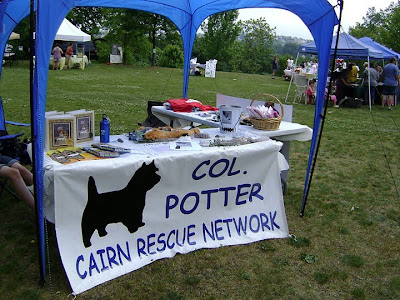
Scranton, PA's first annual Bark @ Nay Aug Park event took place on Saturday, June 5, 2010 and I had the privilege of representing Col. Potter.

There were a good number of vendors and rescues in attendance. Thank you to Puppymill Awareness for their help in putting up our tent. A few sprinkles started the day off, but otherwise the weather was beautiful.


We enjoyed being near the entertainment and even had the head of our local Therapy Dog group (thank you, Barb!) take the microphone and speak on behalf of Col. Potter and cairns, noting their wonderful personalities, of course! CP's Champ, now known as Smudge, was a wonderful ambassador for our cause.

It was truly a group effort and wonderful to see many cairn people from our local area pitch in. A big Thank you to Smudgie's mom, Judy, for being there.

My little sister, Elisabeth (12 y/o), helped in putting together a beautiful display board, taking inventory, packing the items we had for sale and setting up the table.

Col. Potter was able to make contact with several people interested in adopting, a few others who asked about fostering and even meet a couple who had applied to adopt a little cairn boy from another group…we hope we’ll be able to become a resource for them.

Monday, June 7, 2010

Please follow this link to check out the Oz Project website's new look!

Contributed by Kathy C., the 'ozmudder' and tireless CP volunteer


Note from Col. Potter - The Oz Project was began in the summer of 2006. as members of the Col. Potter Cairn Rescue Network since 2003, Kathy C. and her husband began to see the need for a clean, safe, and warm place to bring some of Col. Potter's little rescued cairns. This is the website for this wonderful refuge for some of our most needy rescued cairns.

Hello Everyone,

This week I would like to invite everyone to check out The Oz Project Website. It has a clean new look. If you run your cursor down the column on the left side of the page related pages will pop-up. The left column was getting as long as my arm. This is so much cleaner.

I've also added an Oz Kids Directory. It features every kid that has came through Oz, along with their picture. Talking about pictures, check out the new photo albums that I've added. If you have any pictures of any of these kids please send them along with any information that you have so that I can add it to the website. My computer over heated and died taking so many pictures with it...then the cabin flooded taking paper documents. So if you can, please add pictures or information by sending it to me at ozmudder@gmail.com.

Sunday, June 6, 2010

Vancouver, Winnipeg and Calgary enjoy their Morning Play

Written by Vancouver, Calgary and Winnipeg's foster mom

Here are some pictures of Vancouver, Calgary and Winnipeg playing outside this morning before it is way too hot to be outside.


Vancouver, Winnipeg and Calgary Morning Play

Sunday Sweets

Sunday is full of SWEETS! Each week we will showcase the sweeter side of Cairns. If you have a sweet filled cairn and would like us to consider YOUR picture for an upcoming "Sunday Sweets" send it to us at cpcrnblog@gmail.com! (All photo submissions become the property of CPCRN and may be used for fundraising, promotion and/or outreach purposes.)

Rye

Strawberry

Sophie

Lucy

Wookie

Bree

Baltimore

Saturday, June 5, 2010

SUMMER SAFETY TIPS ARE HERE FOR YOUR PETS ON THE GO!!

By Sandy Robins
msnbc.com contributor
story originally published on msnbc.com


Nikki

Keep your furry friends safe while in the car, at the beach, on the road


The first rule of the road when traveling with pets this summer: never leave them in the car “just for a minute” — not even to get directions or to grab a quick latté.Temperatures inside a vehicle can reach 120 degrees in a matter of minutes, even if you're parked in the shade, warns the Humane Society of America. Dogs and cats don’t perspire as people do and can only dispel heat by panting and through the pads of their feet. Consequently, they don’t stand a chance in a hot enclosed vehicle, and will undoubtedly suffer from heat exhaustion, heat stroke or brain damage — and the consequences can be fatal. Even inside an air-conditioned car, make sure that your pet has easy access to water at all times.


Spill-proof GoTo Bowls are perfect, and fit onto the console of a car or SUV — or you can simply fill a collapsible travel bowl with ice cubes that they can lick to keep well hydrated. Unrestrained pets in a vehicle are considered the third worst distraction when driving, more than cell phones , says the Automobile Association of America. It’s also illegal to travel with unrestrained pets in open pick-up trucks. Not only should pets be restrained in a vehicle, but like small children, they are safer in the back seat.“When driving 35 mph, a 60-pound unrestrained dog can cause an impact of 2,700 pounds, slamming into a car seat, windshield or a passenger,” explains Christina Seltzer, CEO of Bark-Buckle UP, the California-based organization that focuses on educating pet lovers about safety awareness on the road and in the air.

There is a variety of safety harnesses and accessories on the market catering to pets of all sizes. Consider a booster seat for a small dog — it restrains for safety and is elevated so Fido can still enjoy the view.One must-have item for dog owners — a gadget called a Backseat Barrier — is designed to stop dogs from getting into the front seat and distracting the driver. It’s easy to install and remove, and fits into any car or SUV.

If your pet suffers from motion sickness, it’s a good idea to consider a prescription medication called Cerenia, available by prescription from a veterinarian. Natural remedies such as Bach Rescue Remedy can help alleviate the problem too. Does your pet get nervous or too excited on car trips? Pheromone-infused collars can help keep them calm and relaxed. The collars have ingredients that mimic the properties of natural pheromones released by lactating female dogs to calm their puppies. They also contain lavender and chamomile, natural calmatives and are effective for up to a month.

If your dog is a regular passenger in a convertible, consider investing in some flexible eyewear called Doggles. These glasses are designed to keep grit out of the eyes and offer UV protection. Eyewear is particularly helpful for large breed dogs that suffer from pannus, a progressive, non-painful, inflammatory disease of the cornea that is exacerbated by exposure to ultraviolet light. Apart from riding in cars, doggie eyewear is particularly useful for hiking trips and beach excursions.

Outdoor safety

If you are planning a day of fun in the sun, consider letting your dog wear a light T-shirt or a special protective vest to keep harmful rays at bay. Special collars with iced gel sticks will help keep them cool too.Hot sand and sidewalks can be damaging to paw pads. If you can’t avoid such areas, consider ergonomically designed footwear for your pooch. And add paw balm to your list of toiletries to keep them soft and prevent cracking. After an outing, be sure to give your pet a quick shower. Salt water can cause itchy skin, and be sure to check for ticks and stones and debris caught between the toes.

Believe it or not, dogs and cats can get skin cancer. Most pet-specific products usually come with an SPF (sun protection factor) of 15. You can also use a standard zinc-based sunscreen for people that protects against both UVB and UVA radiation. Choose one with a minimum SPF of 30 (if not higher), and apply to the areas that need the most protection — inside tips of the ears, the nose, paw pads and pink tummies.

Hot sand and sidewalks can be damaging to paw pads. If you can’t avoid such areas, consider ergonomically designed footwear for your pooch. And add paw balm to your list of toiletries to keep them soft and prevent cracking. After an outing, be sure to give your pet a quick shower. Salt water can cause itchy skin, and be sure to check for ticks and stones and debris caught between the toes.

Contrary to popular belief, not all dogs are good swimmers. Whether you’re at the beach, or relaxing poolside at home, it's a good idea to keep pets that enjoy water sports safe with a specially designed life jacket. Keep in mind, the fit is very important to ensure movement isn't restricted.The Skamper Ramp is also an excellent accessory on a boat or in a pool, and could save the life of a pet that falls into water unattended.

Hot summer weather also brings out the insects, in particular, dreaded mosquitoes. The American Heartworm Society says cases of deadly mosquito-borne diseases such as heartworm infections are on the rise in domestic pets throughout the United States.Now, you can attach a new mosquito-repelling tag — called Bug Bam — right onto your dog’s collar. It contains 100 percent EPA and FDA approved natural ingredients — geranium, citronella and lemongrass. These essential oils are proven to repel mosquitoes, fleas and ticks without the use of harmful chemicals found in flea collars and topical applications. The tags last for about 15 days.

Hitting the road for vacation? A pet that goes missing out of its territory is truly lost. If you are traveling this summer, consider FasTags. Wherever you are, write your current hotel address on these plastic ID tags with a Sharpie and then shrink them in the oven. By creating a custom tag for each changing location, proper identification is your lost pet’s ticket home. Happy, safe summer travels!

Sandy Robins is an award-winning pet lifestyle writer. She is the recent recipient of the Humane Society of the United States' Pets for Life Award. Her work appears in many national and international publications.

updated 9:53 a.m. ET, Wed., July 15, 2009 msnbc.com


Thank you to Nikki for her beach pose and to Neha, Bea and Zander for posing unrestrained in a pickup truck. Pictures add so much to a story!


Friday, June 4, 2010

Friday's Funnies


Thursday, June 3, 2010

Service Dogs -- Helpful in Many Ways

The Mayo Clinic issued the following news release:

Service Dogs -- Helpful in Many Ways

When disability or illness makes it difficult to open a door, pick up keys or call for help, a service dog might ease these frustrations of daily living.

The December issue of Mayo Clinic Health Letter covers the many different ways that service dogs help people manage their disabilities.

The modern era of service dogs began after World War I, when dogs were trained to guide blind war veterans.

Since then, service dogs have been trained in many specialties, including:

Skilled assistance dogs -- These dogs are trained to help those who are physically disabled. They can open doors, pull wheelchairs, turn on lights, retrieve the telephone or summon help.

Hearing dogs -- These dogs alert their handlers to alarm clocks,doorbells, smoke alarms, approaching vehicles or someone calling the handler's name.

Diabetes response dogs -- These dogs carry objects such as juice bottles and can retrieve a phone or sniff the handler's breath for low blood sugar.

Alzheimer's helper dogs -- These dogs are trained to stay with a person who has Alzheimer's -- or fetch help -- if the person starts to wander or gets into an unsafe situation.

Parkinson's disease helper dogs -- These dogs can assist with balance.

Psychiatric service dogs -- These dogs help people who are disabled by severe mental illness by calming anxieties, prodding their handler to take medications and interrupting harmful compulsions.

Many breeds can be trained as service dogs, but Labrador or Golden retrievers are most commonly used. Their specialized training takes six months to a year. In addition, a week or two of training with a new handler is necessary while learning to work together.

While service dogs can increase safety and independence for people with disabilities, they aren't the right solution for everyone. Even a well-trained dog can misbehave or be annoying. Dogs need exercise, attention, grooming and medical care.

Cost also is a factor.

Usually the cost to train a dog is $10,000 to $20,000, though some charity groups cover this cost.

The Delta Society has a directory of service dog organizations that help train and place service dogs. Many operate as charities, but some charge for their services.

A LIVING LOVE

by Martin Scot Kosins

If you ever love an animal, there are three days in your life you will always remember...

The first is a day, blessed with happiness, when you bring home your young new friend. You may have spent weeks deciding on a breed. You may have asked numerous opinions of many vets, or done long research in finding a breeder.

Or perhaps in a fleeting moment, you may have just chosen that silly looking mutt in a shelter - simply because something in its eyes reached your heart.

But when you bring that chosen pet home, and watch it explore, and claim its special place in your hall or front room - and when you feel it brush against you for the first time - it instills a felling of pure love you will carry with you through the many years to come.

The second day will occur eight or nine or ten years later. It will be a day like any other. Routine and unexceptional. But, for a surprising instant, you will look at you longtime friend and see age where you once say youth. You will see slow deliberate steps where you once saw energy. And you will see sleep when you once saw activity. So you will begin to adjust your friend's diet - and you may add a pill or two to her food. And you may feel a growing uneasy feeling on and off until the third day finally arrives.

On this day - if your friend and whatever higher being you believe in have not decided for you, then you will be faced with making a decision of your own - on the behalf of your lifelong friend, and with the guidance of your own deepest Spirit. But whichever way your friend eventually leaves you - you will feel as alone as a single star in the dark night.

If you are wise, you will let the tears flow as freely and as often as they must. And if you are typical, you will find that not many in your circle of family or friends will be able to understand your grief, or comfort you.

But if you are true to the love of the pet you cherished through the many joy-filled years, you may find that a soul - a bit smaller in size than your own -seems to walk with you, at times, during the lonely days to come.

And at moments when you least expect anything out of the ordinary to happen, you may feel something brush against you leg -- very, very lightly.

And looking down at the place where your dear, perhaps dearest, friend used to lie - you will remember those three significant days. The memory will most likely to be painful, and leave an ache in your heart. As time passes the ache will come and go as if it has a life of its own. You will both reject it and embrace it, and it may confuse you. If you reject it, it will depress you. If you embrace it, it will deepen you. Either way, it will still be an ache.

But there will be, I assure you, a fourth day when - along with the memory of your pet - and piercing through the heaviness in your heart - there will come a realization that belongs only to you. It will be as unique and strong as our relationship with each animal we have loved and lost.

This realization takes the form of a Living Love -like the heavenly scent of a rose that remains after the petals have wilted, this Love will remain and grow - and be there for us to remember. It is a love we have earned. It is the legacy our pets leave us when they go. And it is a gift we may keep with us as long as we live. It is a Love which is ours alone. And until we ourselves leave, perhaps to join our Beloved Pets - it is a Love we will always possess.

Wednesday, June 2, 2010

The Heart of Col. Potter - Please light a candle for JB at the Rainbow Bridge

Written by CP Volunteers and JB's foster mom


JB joined the CP family in January. He was 9 years old and came with only his 4 canines left in his mouth. He was mostly deaf and his vision was poor. He went to a foster home in TX and he was a really, really quiet little guy. He wasn't much on contact with humans, not that he acted scared, rather uninterested. He grew to like being in a home with good food, comfy places to lie down and a nice backyard to potty in and roam around and the company of other dogs.

Unfortunately JB had a stroke or a seizure several days ago. He'd been at the emergency vet ever since getting care 24/7. At first things seemed hopeful but on May 31st, the vet had a different outlook. JB had lost control of his back legs and also of his bowel and bladder. The vet said that JB had very little quality of life and he didn't feel that it would be fair to JB to leave him as he was with little hope of possible recovery. JB's grieving foster mom adopted him so that he went to the Bridge with his own family. Please light your candle for JB and keep his foster mom in your heart.

It's heartbreaking that he only had four months out of a commercial breeding facility but we have to be grateful that he had that much even though it was definitely not enough.

JB was the little boy that found such comfort in his crate with a soft, warm blanket in it during his transport upon pick-up to the vet and was so soundly asleep upon arrival, they thought he was dead until they touched him and his little old, cloudy eyes opened. That was probably the first time in his entire life he had been warm and comfortable on a cold winter's day...

This boy didn't know love, care or comfort for very long, but he did know it thanks to CP and his foster family. JB, do what you have never been able to do - RUN FREE AND HEALTHY as a young dog would. Our candle is lit and I'm checking the night sky for the newest bright shining star ...

Col. Potter rescues cairns which many consider too old, too sick or unadoptable. JB exemplifies the heart of Col. Potter. He was adopted before he went to the Rainbow Bridge and will always be loved and remembered by the entire Col. Potter family.

Wacky Wednesday

Wednesday is the day to be WACKY! Each week we will showcase a terrierific cairn picture with an appropriate caption. If you have a terrierific cairn and would like us to consider YOUR picture and caption for an upcoming "Wacky Wednesday" send it to us at cpcrnblog@gmail.com! (All photo submissions become the property of CPCRN and may be used for fundraising, promotion and/or outreach purposes.)


A big shout out to KAYLA for being the Wacky Wednesday model this week!

Tuesday, June 1, 2010

Sterilizing pets isn't a priority for new owners

By Sharon L. Peters, Special for USA TODAY


Despite campaigns encouraging sterilization to reduce pet overpopulation, and despite expanding options for low-cost spay/neuter surgeries, nearly half of people who have acquired unsterilized pets in the last year haven't fixed them.
Southerners and the under-35 set are the least likely to sterilize their pets.


PAW PRINT POST: Easy way to donate to dogs, cats

Those are among findings from a national survey of 3,000 adults, including 1,000 who have acquired a dog or cat in the past 12 months.

PetSmart Charities commissioned the survey by Ipsos Marketing, released today, in an effort to understand factors contributing to continued pet overpopulation, which results in an estimated 4 million to 6 million shelter animals being euthanized each year. Among findings:

•Of the unsterilized dogs and cats acquired in the past year, 48% still haven't been sterilized.

•38% of 18- to 34-year-olds haven't sterilized their pets, vs. 24% of 55-plus owners.

•13% of dog owners and 19% of cat owners have wound up with litters, more than half of them unintentional.

Overpopulation is underestimated

The survey is the first large-scale effort to quantify the actions and perceptions of pet owners and non-owners relating to spay/neuter, pet overpopulation and adoption of pets from shelters and rescue organizations.

Armed with these data, the animal welfare industry "will be able to be more effective" in accomplishing goals, says Susana Della Maddalena, executive director of PetSmart Charities.

Many pet owners are unaware of the scope of overpopulation: 62% of 18- to 34-year-olds and 47% of 55-plus respondents estimated shelters euthanize fewer than 1 million animals annually; 28% put the euthanasia number at 100,000 or less.

How young is too young?

And there's confusion relating to the age at which pets should be sterilized, owing partly, experts say, to lack of agreement among veterinarians.

Since pets can carry litters when they're just 6 months old, many vets recommend 4 or 5 months as the proper age. But a growing number, motivated by animal welfare advocates who want puppies and kittens sterilized before they go into adopters' homes, believe 2 months is safe.

Among survey respondents who had recently acquired a pet, 17% said they have no idea of the proper age to spay/neuter; 42% said 6 months; 14% said at least 9 months.

People earning $55,000 or more are more likely to adopt from shelters and rescue groups than those earning less; 42% of people who recently got a pet did no prior research, formal or informal.